Schedule

News

Musical Comedies and Musicals in the New Theatre Season

Sales of subscriptions for the 2026/2027 season of the Harag György Company have begun: the seats of existing subscribers will be held until September 23.

Awards for the Harag György Company at the Kisvárda Festival

At the Festival of Hungarian Theatres in Kisvárda, the Harag György Company of the North Theatre Satu Mare received the festival's Grand Prize for its production SOPRO – Whispers in the Dark. Kati Méhes was honoured with a Lifetime Achievement Award, while Blanka Moldován received the award for Best Supporting Actress.

A Charity Gala Brought the Season to a Close

The Harag György Company of the Northern Theatre Satu Mare brought the season to a close with a colourful and entertaining end-of-season gala, which also featured a number of moving moments. The evening included the presentation of numerous professional and audience awards.

The Harag György Company Opens the 13th MITEM

At a press conference held in Budapest on Wednesday, Vidnyánszky Attila, Director General of the National Theatre Budapest, together with Bessenyei Gedő István, Director of the Harag György Company, announced that on April 10 the international theatre festival will open with the two-time UNITER Award-winning production of Richard III, directed by Albu István.
The Bald Soprano
Szaffi
Barefoot In The Park
Sopro - Whispers In The Dark

The Bald Soprano

Characters in The Bald Soprano talk about banal things, they say banal things. But I did not write the play in order to criticise the banality of their words: no, not at all. What they said did not seem banal to me, but, to the greatest extent, shocking and extraordinary.
A comedy was born, although the initial feeling was not one of comedy. Onto this starting point several things were grafted: the sense of the world’s strangeness, the language spoken by people, which became unfamiliar to me, concepts stripped of their content, gestures deprived of their meaning, a parody of theatre, a critique of conversational clichés. I told myself that starting from the simplest elements: arithmetic, the alphabet of arithmetic, if I may put it that way, one could create a play.
To push burlesque to its limits. Here, a dry, unnoticed stumble, and we suddenly find ourselves in tragedy. It is a trick. The transition from burlesque to tragedy must be done in such a way that the audience does not notice it. The characters in The Bald Soprano have nothing to say to each other, yet they constantly chatter about it. (Eugène Ionesco)

Szaffi

The animated film Szaffi, created in the 1980s, was a favorite of many. It later inspired a musical adaptation, which is now being staged for the first time in the repertoire of a theater in Transylvania. The production is intended both for those who would like to relive the story of Szaffi and Jónás, and especially for children who are not yet familiar with this humorous, romantic, and eventful tale.

The performance tells the adventurous story of Szaffi, the daughter of a Turkish pasha, and Jónás, an exiled Hungarian nobleman. Jónás returns to his ancestors’ abandoned estate hoping to find treasure, but his fate becomes intertwined with that of the mysterious young woman. Roma characters also play an important role in the story, supporting the young couple with their wisdom, solidarity, and cheerfulness. After misunderstandings and hardships, the secrets of the past are revealed, and the heroes find their place in the world.

The production highlights the desire for freedom, the search for identity, and the importance of acceptance, accompanied by catchy songs written by Szemenyei János and Galambos Attila.

Barefoot In The Park

Opposites attract. But is this attraction enough for two people to remain happy despite the everyday problems of life? Is it possible to preserve the euphoria of love in marriage? If so, for how long, and what does it take? Is it important to remain true to ourselves or to try to adapt to others? What should we do when conflicts arise? Should we accept that our lives may not be exactly as we dreamed they would be? Can change be both good and bad?

These are all questions that we will all have to face sooner or later. Perhaps this is why Neil Simon's deeply human, sparklingly witty comedy is a hit with audiences around the world, conquering the world's great stages, from Broadway to the West End. Its success has been unbroken since its premiere. The play was adapted into a film in 1967, starring Robert Redford, Jane Fonda, Charles Boyer, and Mildred Natwick.

Sopro - Whispers In The Dark

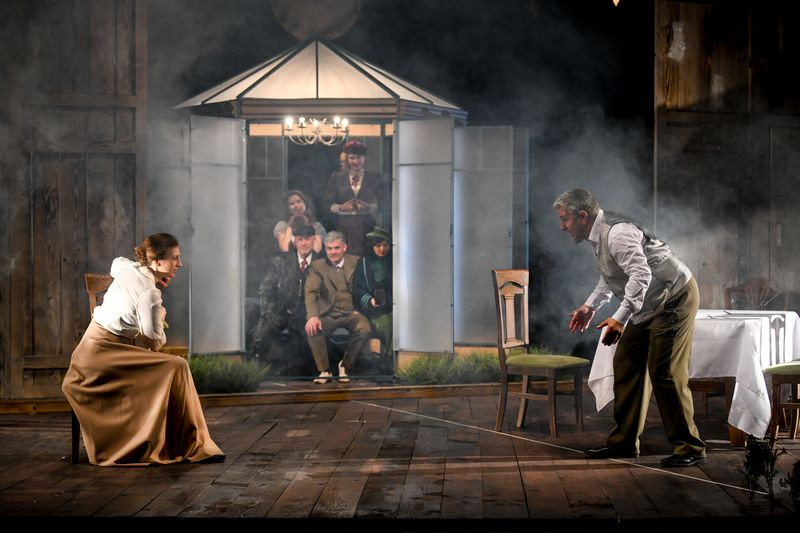
In the theatre, we all breathe the same air. Technicians, actors, audience members—we all breathe the same air. The prompter is the one who breathes with the actors at every moment. He/She watches their every move intently and rescues them when they are most vulnerable, when they get stuck in the text and stand naked, mortal beings on stage in the spotlight. The prompter is the one who remains in the dark throughout his life. 
In this performance, the prompter takes to the stage for the first time in his life.
The Story of the Caliph Stork
East of the Sun, West of the Moon
The ghouls are in Town

The Story of the Caliph Stork

The magical East continues to captivate the imagination of both children and adults, which is why stories like One Thousand and One Nights and other oriental tales keep reappearing in various forms and adaptations. One of Wilhelm Hauff’s best-known tales, The Story of the Caliph Stork, takes its audience into this mysterious Eastern world. The story builds on the human curiosity of what it would be like to “step into an animal’s skin” and understand their language and behaviour. However, curiosity and acquired knowledge can also carry dangers—an important lesson even from an early age. The Caliph and the Grand Vizier forget this and seem doomed to remain storks forever. Yet, as in life, there is always a chance to correct mistakes—but sometimes, in order to help ourselves, we must first solve the problems of others.

East of the Sun, West of the Moon

The Norwegian folktale on which the play is based is one of the finest examples of the “animal bridegroom” motif, a recurring theme in ancient folk traditions. The heroine must embark on a long journey and endure incredible adventures in order to rescue her beloved, an enchanted prince who appears in the form of a polar bear. Along her perilous quest, she is hindered by a living forest, a mighty troll, and an ice-hearted princess, while three mysterious women—spinners of fate and storytellers—weave her path and guide her toward her love. With their help, she reaches the palace at the edge of the world, east of the Sun and west of the Moon.

The ghouls are in Town

The fairy in the fairy tale visits people only when she feels like it, says Andersen in his story. But what if she doesn't come? If we can't find it in the desk drawer or under the bed, on the verge of laughing or crying? Well, then you have to go looking for it. So does our protagonist, Regelaki Pömpöllér. But it's not the fairy tale fairy she meets, but the bog witch, who tells her about the witches. She needs help, because the Ghouls are already in town. Let there be a man at the bottom (and above) who will pick them up and bring them back to the bog world before they mess with people's souls. Our protagonist sets out and does what being a hero requires. Then we can only wonder, have you found your fairy or not? (I'll help you: he has.)
Passion and Devotion
Nora Project
Kohlhaas

Passion and Devotion

Passion and Fidelity, a historical monodrama written by Mária Hedry, unfolds during the sea voyage of the exiled Ilona Zrínyi as she travels to Turkey to join her husband, Imre Thököly, who is living in exile there.
The play captures the defining moments of Ilona Zrínyi’s life with remarkable concision, weaving them into the portrait of an extraordinary woman through the expressive power of drama. Drawing on key episodes from her life, it reveals her strength, devotion, and unwavering spirit.
This production is part of the Endre Ady Society’s Great Hungarian Women series.

Nora Project

They gather regularly. Yet today, somehow, everything feels different. Perhaps it is the music, or the silence... perhaps the unusual setting, or the newcomer attending such a gathering for the first time. Perhaps it is an Ibsen play that sparks a conversation—or perhaps it is all of these things together.
Henrik Ibsen’s Nora (better known in English as A Doll’s House), one of the playwright’s most celebrated works, has remained a constant presence on stages around the world since its premiere in 1879. The title character’s decision to leave what appears to be an ideal marriage was considered shocking in its time and turned the play into a scandalous sensation at its first performances. As a powerful statement on women’s rights and social position, the drama has inspired countless reinterpretations throughout the twentieth and twenty-first centuries.
This production, however, does not retell Ibsen’s familiar story. It was created around Nora, through Nora, because of Nora—developed from the actors’ improvisations and shared conversations. It is not so much about Nora as it is about us.
Seven women, seven lives, seven worldviews come together on this evening. In tracing the meaning of what it means to be a Nora today, they may discover far more than they expected.
Warning: the same may happen to our unsuspecting audience.

Kohlhaas

A new stage adaptation of Heinrich von Kleist's classic short story tells the story of a man who is willing to go to the end for justice. The horse-dealer Michael Kohlhaas is "one of the most vicious, yet most wicked men of his time". One day, on their way to a fair, two of Kohlhaas' horses are illegally seized in the Wenceslas field in Tronka. Later, the horses are returned to him in an undignified state, and he tries in vain to claim compensation through legal channels. After repeated refusals, he has no choice but to seek justice himself, at any cost.